An AI Ready CMO vs Marketing Engineer comparison is really a choice between two kinds of ownership: who decides what marketing should do, and who builds the system that gets it done.
Disclosure: O-CMO defines and offers these scopes, separately or together. “AI Ready CMO” is our proposed competency standard for marketing leadership, not a claim that every CMO has completed a universal certification.
The short version: Choose an AI Ready CMO when your team lacks senior marketing direction, priority decisions, or accountability for outcomes. Choose a Marketing Engineer when the direction is already clear but recurring work is slowed by fragmented context, manual handoffs, or unreliable workflows. Hire both when weak strategic ownership and weak execution systems are blocking the same goal. The CMO owns the marketing decision; the Engineer owns the working process that carries it out.
Start With the Ownership Gap
The titles matter less than the decisions each person must own. A company that needs a market choice will not solve that gap with another automation. A company that has already chosen its market and priorities may not need another strategist to restate them.
The first diagnostic question is simple:
Is the problem deciding what the team should do, or building a reliable way to do it?
| Decision area | AI Ready CMO | Marketing Engineer |
| Market and offer | Owns the strategic choice | Uses the approved choice as an input |
| Priorities and budget | Chooses what receives resources and what stops | Works within the approved priority and scope |
| Process design | Sets the business goal and acceptance standard | Maps inputs, steps, tools, handoffs, and failure rules |
| Implementation | Removes dependencies and leads adoption | Builds, tests, documents, and maintains the workflow |
| Quality | Accepts the business usefulness of the result | Tests whether the process produces the agreed output |
| Measurement | Connects the work to marketing and business goals | Measures cycle time, acceptance, failures, and operating cost |
This boundary does not mean the CMO avoids systems or the Engineer avoids judgment. An AI Ready CMO needs enough technical understanding to choose where a new workflow is worth the cost. A Marketing Engineer needs enough marketing judgment to challenge a weak specification and propose a better process. The boundary is final accountability.
If the leadership role itself is unfamiliar, start with what a Fractional CMO is and what a Fractional CMO does.
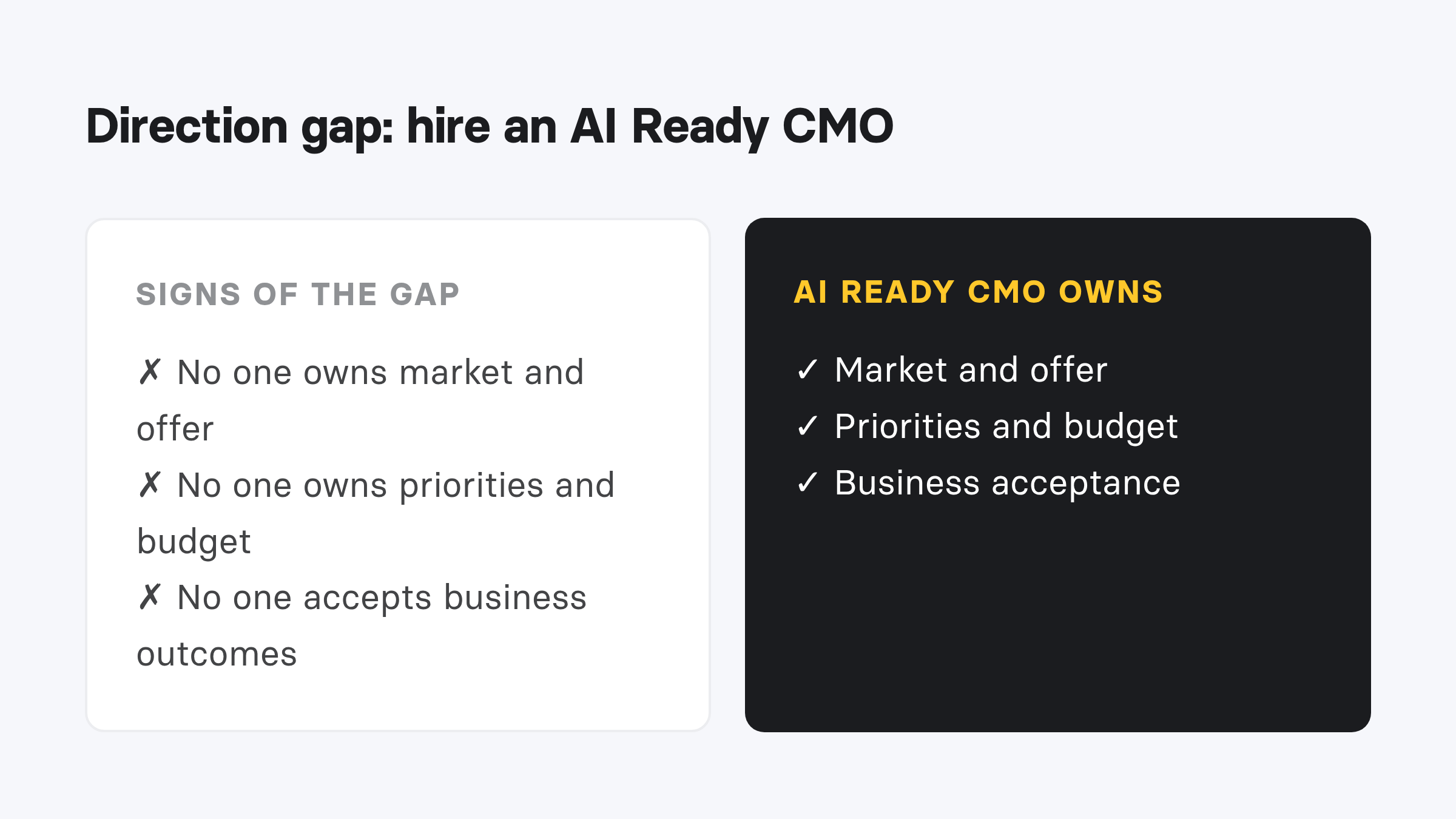
Choose an AI Ready CMO When Direction Is Missing
An AI Ready CMO is a senior marketing leader who can set direction, allocate resources, and change how the team works with people, data, tools, and AI. The role is not “the person who uses the most AI.” Its value is deciding where a different operating model should create useful capacity, then directing that capacity toward an agreed marketing goal.
You likely need this role first when:
- the founder still chooses most marketing priorities;
- the team has a long backlog but no clear order or owner;
- channels run as separate activities rather than one plan;
- AI experiments exist, but no leader decides which should enter regular work;
- nobody can approve the market, positioning, budget, or success criteria;
- the company is preparing to hire senior marketing leadership but needs direction now.
The output should not be another list of tools. It should include a clear marketing goal, a smaller set of priorities, a resource plan, decision rights, and a reason to stop or defer lower-value work.
An AI Ready CMO may identify a workflow that needs engineering. That does not make the leader responsible for personally building every integration. It makes the leader responsible for selecting the right process, funding it, setting acceptance criteria, and deciding what happens after the result is reviewed.
Choose a Marketing Engineer When Execution Is the Bottleneck
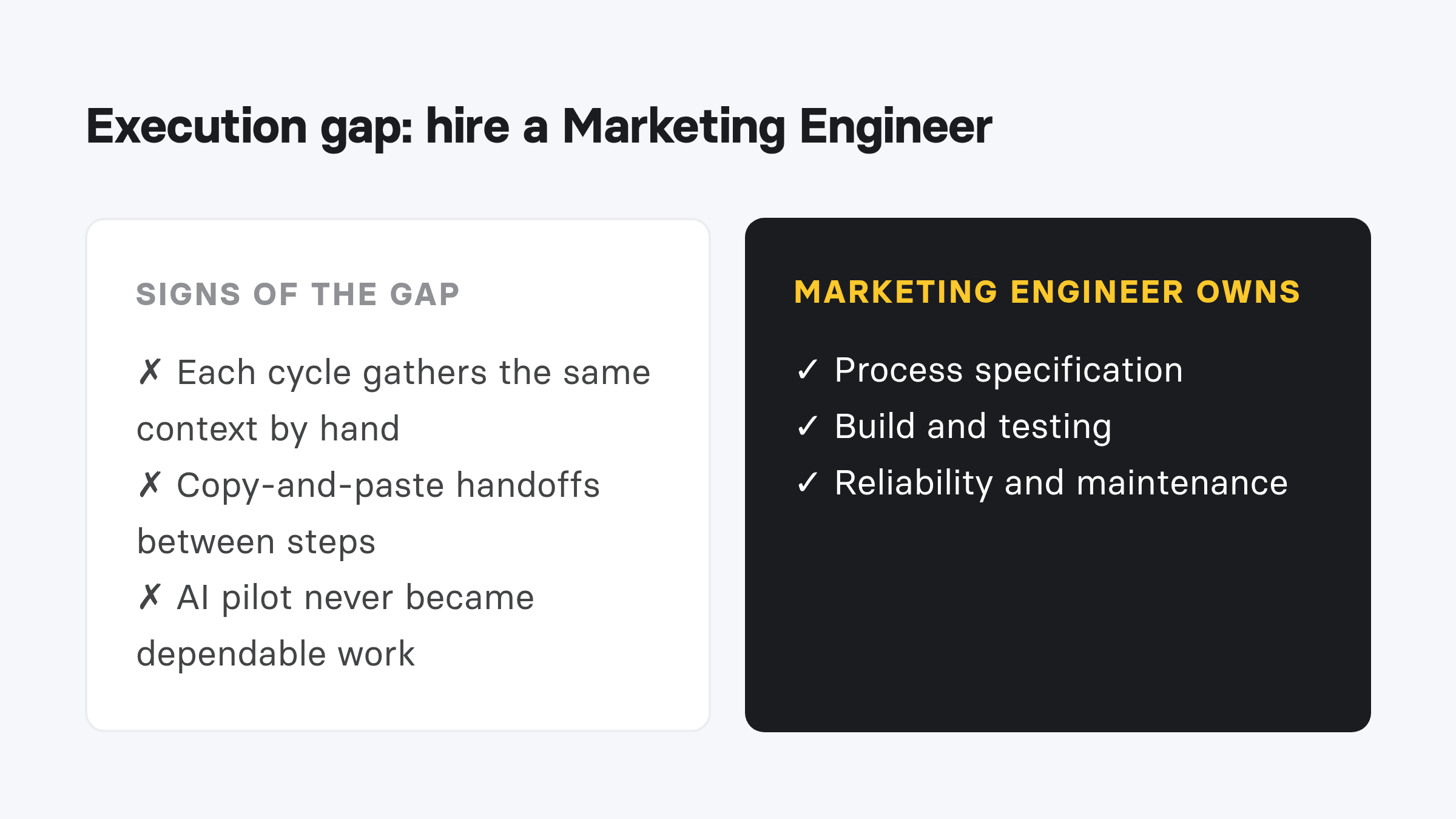
A Marketing Engineer turns an approved marketing priority into a system that the team can run, review, and improve. The work combines process design, structured context, data, tools, quality control, and human approvals.
You likely need this role when:
- a CMO, Head of Marketing, or founder already owns the direction;
- the same important task repeats often enough to justify a system;
- the team starts each cycle by gathering the same context manually;
- work moves through fragile copy-and-paste handoffs;
- an AI pilot produced interesting outputs but never became dependable work;
- the company can name the input, accepted output, reviewer, and baseline problem.
The deliverable is a working process, not a collection of prompts. For example, a Marketing Engineer might connect approved customer-call notes to a source-linked insight workflow, define how insights become briefs, require a named reviewer to accept each brief, and record corrections for the next cycle.
The detailed guide to what a Marketing Engineer does explains the role, systems, handoffs, and evaluation in more depth. This comparison stays focused on which scope to buy.
Match the Role to the Buying Situation
Most companies fall into one of three buying situations. Diagnose the situation before discussing tools or headcount.
1. The team is busy, but nobody owns the choice
Illustrative situation: A tech company runs content, paid acquisition, events, and partner activity. Each channel has work in motion, but the CEO still resolves priority conflicts and no one can explain which segment or offer should receive the next quarter’s resources.
Buy first: AI Ready CMO.
The leadership task is to select the goal, market, priorities, and resource trade-offs. Engineering before that decision would make an arbitrary process faster. Once the CMO identifies a valuable recurring bottleneck, a Marketing Engineer can scope its implementation.
2. The priority is clear, but every cycle starts from zero
Illustrative situation: A Head of Marketing has chosen a segment and knows that customer evidence should drive campaigns. Interview notes, CRM records, support conversations, and approved product facts are scattered. Each new brief requires manual collection and quality depends on who remembers the context.
Buy first: Marketing Engineer.
The direction already has an owner. The engineering task is to define trusted inputs, create the transformation steps, specify review rules, test known cases, and establish maintenance. The Head of Marketing continues to decide which insight matters and which campaign to run.
3. The team lacks direction and a dependable operating system
Illustrative situation: A founder wants more consistent demand generation and expects AI to increase team capacity. The company has neither an agreed channel priority nor a reliable process for turning customer evidence into experiments.
Buy together: AI Ready CMO plus Marketing Engineer.
The CMO owns the marketing goal, selects the first process, and defines the business acceptance criteria. The Engineer maps and builds that process. The client assigns a person who supplies access, reviews outputs, and accepts changes in day-to-day work.
Use One Shared Process When You Hire Both
Two scopes should not create two disconnected audits. Use one diagnostic and one operating record, with separate decisions and outputs.
| Stage | AI Ready CMO | Marketing Engineer | Client owner |
| 1. Set the target | Defines the marketing goal, priority, constraints, and baseline | Tests whether the candidate process is observable and feasible | Confirms access, people, and decision authority |
| 2. Specify the process | Defines business usefulness and acceptance | Maps inputs, outputs, tools, handoffs, permissions, and failure cases | Confirms current work and source owners |
| 3. Run a bounded cycle | Keeps the work tied to the priority | Builds the smallest usable flow and tests it on real tasks | Reviews and accepts or rejects outputs |
| 4. Measure the change | Reviews whether new capacity was used for the intended initiative | Measures accepted output, review effort, cycle time, failures, and cost | Confirms operational impact and unresolved dependencies |
| 5. Decide the next step | Chooses to scale, revise, stop, or redirect the work | Documents changes and the support requirement | Assigns the next internal owner |
This sequence protects both sides from false certainty. A workflow can function technically and still fail to produce useful marketing work. A sound strategy can remain a presentation if nobody builds the operating path. The shared review must examine both.
Scope the Engagement Before You Buy
Use the following questions to determine whether you need leadership, engineering, or both.
| Scoping question | If the answer is unclear | Likely lead role |
| Who can choose the market, offer, and marketing priority? | The strategy owner is missing | AI Ready CMO |
| Who can approve budget and stop lower-priority work? | Resource authority is missing | AI Ready CMO |
| Which recurring process is blocking the approved priority? | The implementation target is not defined | CMO first, then Engineer |
| What inputs are trusted, current, and permitted for use? | The process foundation is weak | Marketing Engineer with source owners |
| What output will a named person accept? | Quality has no owner | Both roles plus the client owner |
| How will you compare the new process with the current one? | The value cannot yet be evaluated | Both roles |
| Who will maintain the process after the first build? | The workflow may become another abandoned pilot | Marketing Engineer |
Write the answers into the scope. Role labels are not enough. A useful proposal names the decision rights, first process, source owners, review time, accepted output, measures, exclusions, and next-step rule.
When evaluating people for either scope, ask for evidence of decisions and operating work, not a tour of fashionable tools. The same principle used to vet a Fractional CMO applies here: inspect the problem, the person’s ownership, the work produced, how quality was checked, and what changed after a failure.
Avoid Four Common Buying Mistakes
Buying engineering before choosing a priority
Automation cannot resolve an unowned strategy decision. It can only encode the current assumption. Set the market goal and decision owner before building.
Hiring leadership for a narrow systems problem
If a capable marketing leader already owns direction and one recurring workflow is the bottleneck, a broad leadership engagement may duplicate authority. Scope the process instead.
Treating AI use as evidence of readiness
Tool fluency is not the same as operating responsibility. Ask how the person chooses use cases, sets permissions, handles bad output, measures review effort, and decides whether to stop.
Combining both roles without separating acceptance
One person can cover both scopes, but the contract should still separate them. The leadership output is an approved decision and resource direction. The engineering output is an accepted, maintainable process. Evaluate each on its own criteria.
Methodology: This comparison uses O-CMO’s approved October 2026 service model for the AI Ready CMO and Fractional Marketing Engineer scopes, plus the current O-CMO guides to Fractional CMO responsibilities, Marketing Engineer systems, and leadership vetting. The three buying situations are illustrative, not client case studies. Sources and links were checked in October 2026.
Frequently Asked Questions
Can a Marketing Engineer replace a CMO?
Not by default. A Marketing Engineer can design and run systems, but someone still needs authority over market choice, positioning, budget, priorities, and business accountability. One person may cover both scopes when those decision rights are explicit and the person has evidence in each area.
Does an AI Ready CMO build automations?
The CMO may build or configure some systems, but that is not the role’s defining ownership. The CMO chooses where a process change is valuable, sets the business requirements, leads adoption, and decides what to do with the result. Specialized engineering can be scoped separately.
Can we hire a Marketing Engineer without a CMO?
Yes, if a founder, Head of Marketing, or another senior owner can make the strategic decisions and accept the workflow’s outputs. Without that owner, the Engineer would be asked to make unapproved market and budget choices.
What should the first joint project cover?
Start with one marketing priority and one recurring process. Define the baseline, trusted inputs, accepted output, reviewer, permissions, measures, and next-step rule. Do not make “transform the marketing function” the first implementation scope.
How do we evaluate one person who claims to do both?
Assess the scopes separately. Ask for a strategic decision the person owned, the trade-offs and resources involved, a process they built, the quality checks used, and a correction made after failure. Then confirm which decisions the person would own in your company.
The Bottom Line
Choose an AI Ready CMO when the missing capability is senior marketing direction. Choose a Marketing Engineer when the direction exists but the team lacks a reliable system to execute it. Choose both when the same goal is blocked by weak decision ownership and weak operations, then separate what each role must deliver and who accepts it. Discuss whether your team needs marketing leadership, workflow engineering, or both with O-CMO.